A. INTRODUCTION
1. In the Federal Court’s landmark decision in Robinder Singh Jaj Bijir Singh v. Jasminder Kaur Bhajan Singh [2024] 3 CLJ 647, the apex court resolved a key procedural controversy that had plagued matrimonial practice for years: whether matrimonial cause papers filed under the Law Reform (Marriage and Divorce) Act 1976 (“LRA 1976”) and the Divorce and Matrimonial Proceedings Rules 1980 (“DMPR”) may be filed in English only, without an accompanying Bahasa Malaysia translation.
2. The decision has significant ramifications for family law practitioners, registry administrators, and the broader legal community, particularly in light of longstanding reliance on Registrar’s Circular No. 5/1990, a directive that had, until now, sat in uneasy tension with Order 92 Rule 1 of the Rules of Court 2012 (“ROC 2012”).
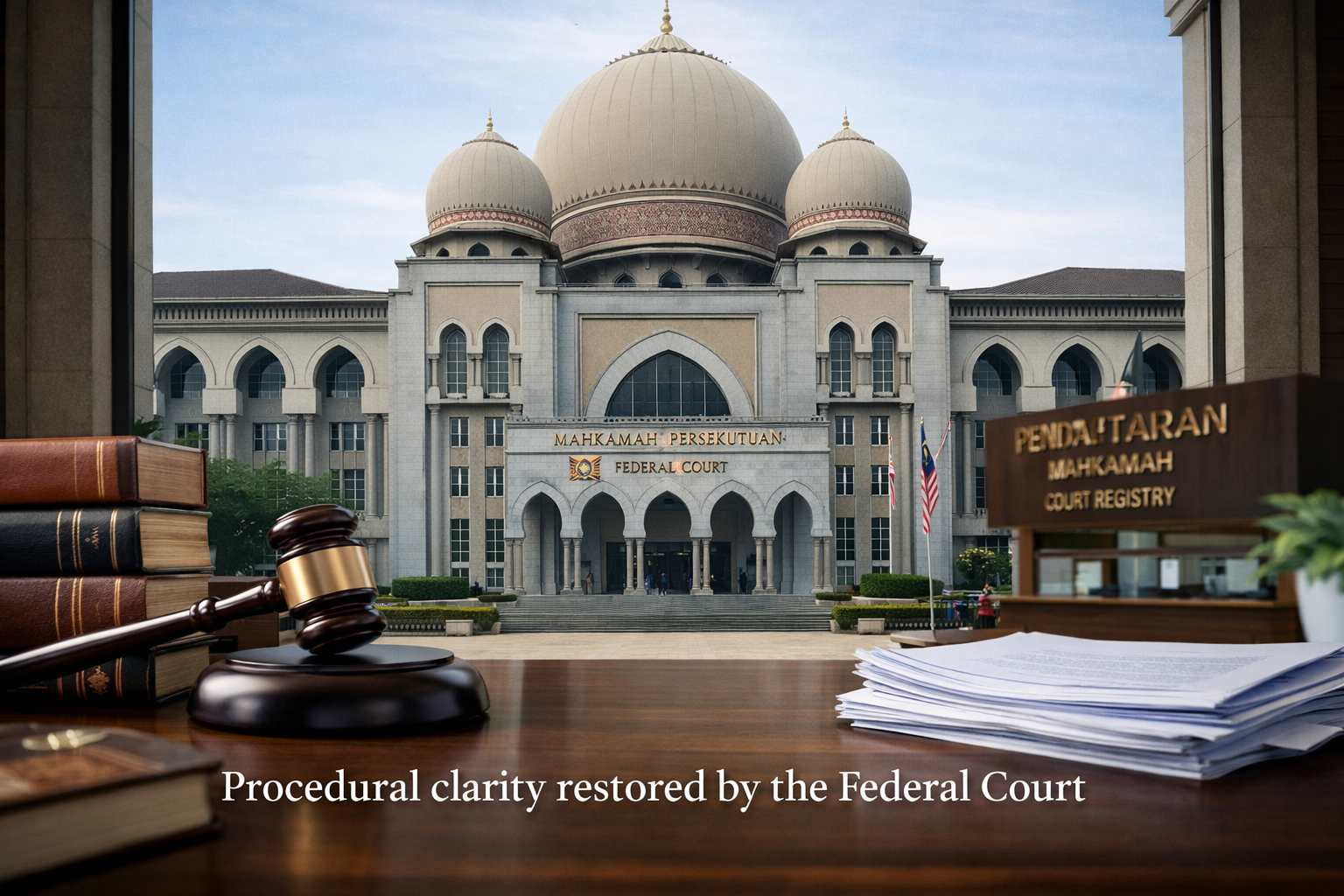
3. The Federal Court held that the ROC 2012 do not apply to matrimonial proceedings governed by the DMPR, and that cause papers under such proceedings may validly be filed in English, thereby affirming the legal efficacy of the Registrar’s Circular and restoring uniformity across jurisdictions.
B. BACKGROUND FACTS
4. The appellant and respondent were parties to a broken-down marriage. The respondent filed an ex parte application at the High Court seeking interim sole custody and control of their child.
5. The application was granted, but the order was not served and lapsed after 21 days. A second application was filed in similar terms.
6. The appellant applied to set aside the original ex parte order (Encl. 20), arguing that it was improperly obtained, that there was no urgency, and that there was non-compliance with procedural rules including O. 29 r. 1 ROC 2012, r. 61(1) and r. 91 DMPR.
7. While a separate application (Encl. 26) was resolved via consent, the appellant sought for Encl. 20 to be heard, primarily to address damages suffered as a result of the initial ex parte order.
8. The High Court, however, dismissed Encl. 20 on the sole ground that the appellant had failed to file a Bahasa Malaysia translation of the application within the two-week deadline ordered by the Court, invoking O. 92 r. 1(4) ROC 2012.
9. The Court of Appeal affirmed this view, holding that the Registrar’s Circular could not override the requirements of the ROC. Leave to appeal was granted on three questions of law.
C. QUESTIONS BEFORE THE FEDERAL COURT
10. The Federal Court was asked to determine:
10.1. Whether petitions for judicial separation or divorce filed pursuant to the LRA 1976 and DMPR may be filed in English only;
10.2. If so, whether all other cause papers (including interlocutory applications and affidavits) in matrimonial proceedings may also be filed in English only; and
10.3. If not, whether such filing in English only constitutes an irregularity curable by court direction.
11. The Federal Court answered the first two questions in the affirmative and declined to answer the third.
D. LEGAL FRAMEWORK AND INTERPRETATION
D1. ROC 2012 INAPPLICABLE TO MATRIMONIAL PROCEEDINGS
12. The Federal Court began its analysis by affirming that the Rules of Court 2012 apply only to proceedings governed by those rules. Under Order 1 rule 2(2) ROC 2012, the Rules “do not have effect in relation to proceedings in respect of which rules have been or may be made under any written law.”
13. Matrimonial proceedings under the LRA 1976 are regulated by the DMPR, a distinct set of rules promulgated under Section 108(1) of the LRA. These rules govern all aspects of divorce and related reliefs.
14. Further, Appendix C of the ROC 2012, which lists exempted statutes, specifically includes matrimonial proceedings under the LRA 1976 (Item 5). This exclusion is reinforced by Order 94 rule 2(2) ROC 2012, which states that if there is any inconsistency between the ROC and rules made under specific statutes, the latter shall prevail.
D2. Validity of Registrar’s Circular No. 5/1990
15. Registrar’s Circular No. 5/1990 was issued following the enactment of the National Language (Amendment) Act 1990, which inserted a requirement under Section 8 of the National Language Acts 1963/67 for all court proceedings to be conducted in Bahasa Malaysia.
16. In response, the Registrar issued Circular No. 5/1990, clarifying that matrimonial, bankruptcy, and winding-up proceedings may continue to be filed in English until the relevant procedural rules are translated and gazetted.
17. The DMPR remains untranslated to this day. As such, the Circular has continued validity. This was confirmed in 2019 by the Family Law Committee of the Malaysian Bar and the High Court in Kuala Lumpur.
18. The Federal Court found that the Circular aligns with Rule 105 of the DMPR, which allows the Chief Justice to issue directions to ensure procedural uniformity in matrimonial courts.
D3. Injustice Caused by Misapplication of ROC 2012
19. The Federal Court strongly criticised the High Court’s decision, stating that it effectively punished a litigant for relying on an official directive issued by the judiciary.
20. By dismissing Encl. 20 purely for failure to translate the application — when no translation was legally required — the High Court denied the appellant access to justice and equal protection of the law, contrary to Articles 5 and 8 of the Federal Constitution.
21. The Court reiterated that Practice Directions and Circulars are part of the justice system and must be interpreted harmoniously with enabling statutes and rules, not cast aside arbitrarily.
E. DECISION OF THE COURT
22. The Federal Court
22.1. Allowed the appeal, and set aside the decisions of the High Court and Court of Appeal;
22.2. Held that petitions and all cause papers filed under the LRA 1976 and DMPR may be filed in English only, pending official translation and gazettement of the DMPR;
22.3. Affirmed the continued validity of Registrar’s Circular No. 5/1990;
22.4. Declined to answer the third question of law, finding it unnecessary given the conclusions on the first two.
F. IMPLICATIONS AND COMMENTARY
F1. CERTAINTY AND UNIFORMITY RESTORED
23. This decision resolves years of inconsistent practices across Malaysian courts. Some registries (e.g. Kuala Lumpur, Penang) accepted English-only filings; others (e.g. Malacca) rejected them. The judgment restores nationwide procedural coherence.
F2. PRACTICAL GUIDANCE FOR LEGAL PRACTITIONERS
24. Lawyers handling matrimonial proceedings may confidently file cause papers in English without the need for translation, until the DMPR is officially translated and gazetted.
25. Where registry staff resist such filings, this judgment may be cited as binding Federal Court authority affirming the right to English-only documents under the current legal framework.
F3. BROADER IMPACT ON OTHER PROCEEDINGS
26. The judgment affirms similar long-standing practices in bankruptcy and winding-up proceedings, which also rely on the Registrar’s Circular. Thus, it has cross-domain procedural value beyond family law.
F4. CONSTITUTIONAL UNDERPINNING
27. Perhaps most importantly, the case reaffirms the constitutional imperative that procedural rules must serve — not frustrate — substantive justice. The Court’s invocation of Articles 5 and 8 FC affirms the right of litigants to fair, equal, and meaningful access to justice, irrespective of linguistic technicalities.
G. CONCLUSION
28. Robinder Singh is a landmark judgment that goes beyond technical rule interpretation. It affirms the role of judicial discretion, administrative directives, and the constitutional right to be heard.
29. The decision will undoubtedly serve as a cornerstone precedent for family law and procedural justice in Malaysia.
This article is prepared by Vhimall Murugesan