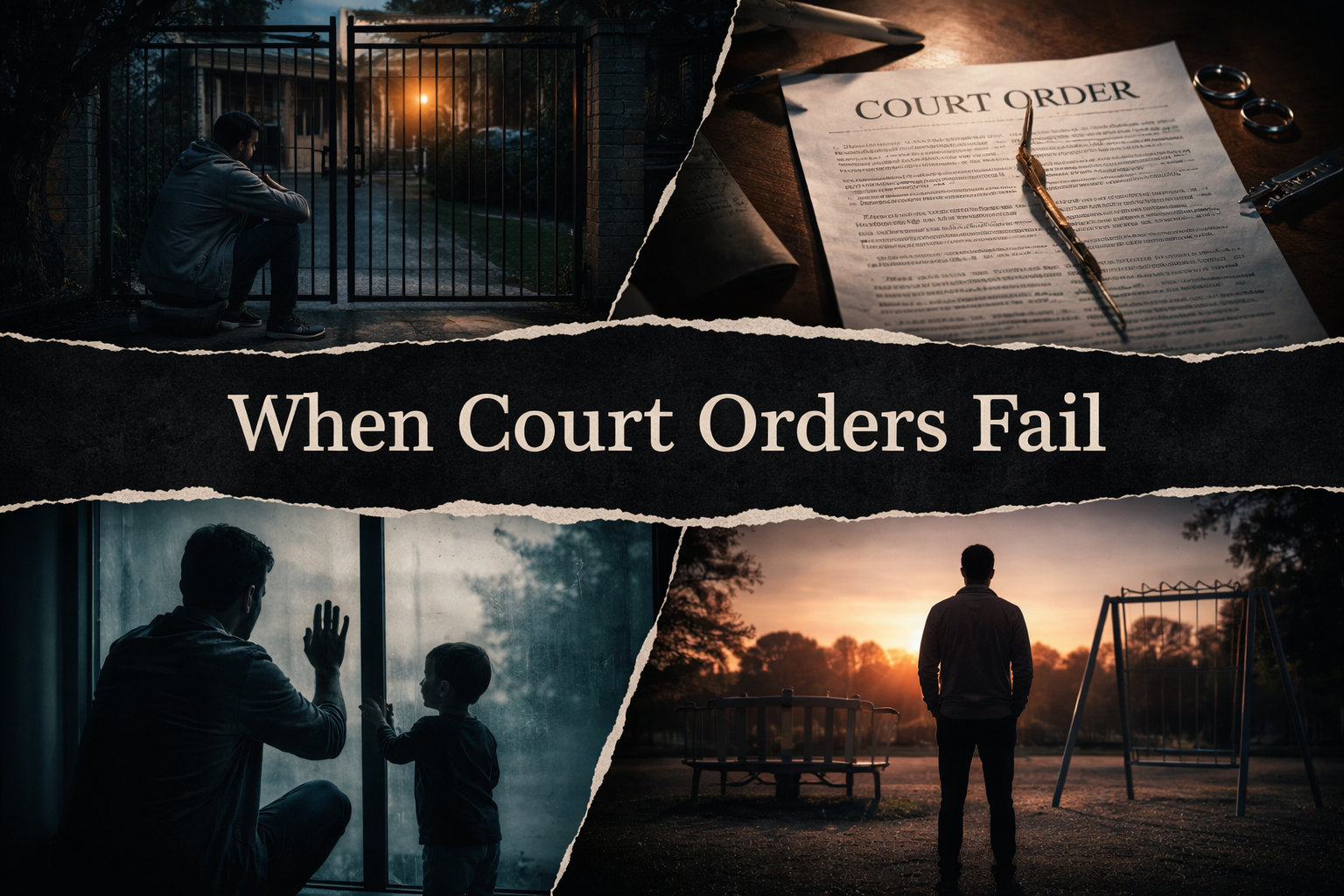
A court order for child access is often a father’s only lifeline, yet for many, it remains just a piece of paper. We have sat with fathers who arrive at pickup points only to find locked gates and silenced phones—a recurring cycle of "gatekeeping" that turns a legal right into a weekly heartbreak.
When access is denied, the law offers "contempt of court" as a remedy, but the road to enforcement is paved with exhaustion. We’ve seen men hesitate to file committal proceedings, not out of weakness, but out of fear that escalating legal tension will further alienate their children.
This creates a cruel paradox: a father must choose between fighting for his rights and being labeled "high conflict," or remaining silent and risking becoming a stranger to his own child. Enforcement must be swifter and the consequences for non-compliance firmer; a child’s right to their father should never be a request—it must be a reality the law is brave enough to protect.
If you are currently being denied your court-ordered time, the law provides a framework for recourse.
Taking Action: Essential Steps to Protect Your Parental Rights
If your court-ordered time is being obstructed, it is vital to move from frustration to strategic legal action. We recommend these four immediate steps:
Maintain Meticulous Documentation: Keep a precise log of every missed visit. Save all screenshots of text messages, emails, and call logs where access was refused or ignored. This data serves as your primary evidence in court.
Lodge Formal Police Reports: While authorities often categorize these disputes as a "civil matter," a formal report creates an official, contemporaneous record of the breach. These reports are vital for proving a persistent pattern of non-compliance to a judge.
From a litigation standpoint, the next step involves having your solicitor issue a formal Letter of Demand. This acts as a final warning, making it clear that continued obstruction will lead to committal proceedings. Under Order 52 of the Rules of Court 2012, you may apply for leave to cite the other parent for contempt—a serious legal mechanism where the court can impose fines or even imprisonment to compel respect for the judicial order.
At our firm, we believe that a court order must be more than a suggestion—it must be a sanctuary. For too long, fathers have been forced to navigate a "Paper Wall" where their rights exist in theory but vanish in practice. We have seen the exhaustion in the eyes of men who simply want to be present for the milestones, the laughs, and the daily growth of their children.
Enforcement must be swifter to reflect the gravity of the bond at stake. A child’s right to their father is not a request; it is a fundamental necessity. We remain committed to tearing down these barriers and ensuring the law is brave enough to protect the love it claims to uphold. Let the law finally reflect the reality that a father is not an occasional visitor, but a constant, vital presence.
A child doesn't need a visitor; a child needs a father. Let the law stop being a 'Paper Wall' and start being the bridge that brings them home.
This Article is prepared by Rachel Pravithra Ravindran LL.B (Hons) BTC LL.M